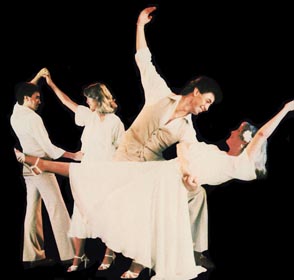
1970s Disco Dances
Richard Powers
During the 1960s, New York City Hispanics—largely Puerto Rican and Cuban—kept the 1950s teen tradition
of Bandstand-style swing alive, at the St. Mary's Church dances in the Bronx
and elsewhere, partially because it had always been considered masculine for Latino men to dance. When the disco scene
erupted in New York City in 1970, partnered dancing was revived, with the disco dancers adopting the local teen's style of swing
kept alive by Latinos during the sixties. The term Latin Hustle therefore refers to the NYC Hispanics who were still
dancing this way, not because it's a from a Latin American country (it's not). The structure, step patterns and figures of disco
Hustle are all essentially the same as 1950s American teen
jitterbug/bop, which had been mothballed for a decade. However the music was new, as was a more upright walking style, which gave this form of swing
an entirely different look and feeling. My page on the disco lifestyle is here.
 Both partnered and solo dancing were done throughout the Disco Era, but the proportions changed dramatically in 1978.
During the first eight years, disco dancing was primarily partnered dancing, the living tradition of swing. To quote Maria Torres,
a disco dancer from NYC, "The thing which really killed partner dancing
was Saturday Night Fever. Disco was originally an underground dance, done mainly by Hispanics,
blacks and gays, who could really do partner dancing. They were incredible, but that was an underground thing.
Then when Saturday Night Fever came out, the masses flocked to the clubs to experience what they saw in the
movie. But what they thought the Hustle was was freestyle, because that's what John Travolta did." Partnered
Hustle did continue, but was somewhat overshadowed by freestyle solo dancing in the final two years of the disco craze.
Both partnered and solo dancing were done throughout the Disco Era, but the proportions changed dramatically in 1978.
During the first eight years, disco dancing was primarily partnered dancing, the living tradition of swing. To quote Maria Torres,
a disco dancer from NYC, "The thing which really killed partner dancing
was Saturday Night Fever. Disco was originally an underground dance, done mainly by Hispanics,
blacks and gays, who could really do partner dancing. They were incredible, but that was an underground thing.
Then when Saturday Night Fever came out, the masses flocked to the clubs to experience what they saw in the
movie. But what they thought the Hustle was was freestyle, because that's what John Travolta did." Partnered
Hustle did continue, but was somewhat overshadowed by freestyle solo dancing in the final two years of the disco craze.

The original script for Saturday Night Fever called for only partnered dancing, as
was actually done at the 2001 Odyssey club in the story. But John Travolta felt that a solo dance would better develop the character arc of
the storyline, and insisted that the script be changed to feature him doing solo freestyle dancing. Travolta said, "I had to enforce that
scene. They were basing this movie on his being the best dancer, and he didn't have a solo. I had to prove to the audience that
he was the best." Little did he know that his added scene would change the dynamic of disco dancing.

Another reason for the later increase in freestyle solo dancing was the shift in focus to heavier drinking during the Disco Fever years.
44,000 new disco clubs sprouted up in one year, partially because liquor sales were
so profitable, and clubs devised new ways to encourage drinking. Partnered dancing required considerable (and fairly sober) skills,
while freestyle and line dancing could be done while intoxicated.
But the partnered Hustle remained the focus of serious disco dancing, and the eighty how-to-disco books that were published after Saturday
Night Fever focused on partnered dancing.
Author's note: Your source for this page has first-hand experience. I worked as a
media and club designer for a large network of discos (New York, Boston, Ft.
Lauderdale, Buffalo, Cincinnati, Minneapolis and Houston) in the seventies, from before Saturday Night Fever launched the disco fad, until
after it all subsided. I traveled to all of these clubs, participated in the huge NYC disco conventions, and record companies
sent me their latest disco recordings as soon as they were released.
Thus I had a chance to see all of the phases of the disco craze. In addition, I've reconstructed the dances from 78
disco dance books and LP record descriptions that were published between 1974 and 1981 (see the bibliography at the bottom of this page).
Other primary sources include interviews with former disco dancers, and film and video from the 70s.


HUSTLE STEP PATTERNS
Latin Hustle (also called The Hustle, Latin-Swing, New York Hustle, and Manhattan Spanish Hustle)
This was the most commonly described Hustle in the disco dance manuals.
Man: Tap L foot to the L without weight (or tap in place, or tap crossing behind)
Close L to R with weight
Quick step back R. Quick close L to R with weight
Step forward R
Step L
Step R
Count: 1 2 3 and 4 5 6.
Woman steps opposite, beginning R.
The last 3 steps can be done in place, forward or backward, as needed.
 There were also several other step patterns called Latin Hustle, varying regionally and over time.

American Hustle (also called The Hustle, New York Toe Hustle, and Easy Hustle)
Man: Taps L foot to the L without weight (or tap in place, or tap crossing behind)
Close L to R with weight
Tap to the R side without weight
Close R to L with weight either in place or start walking forward R
Step L either in place or rock back or travel forward
Step R either in place or replace or travel forward
Woman steps opposite, beginning R.
The last 3 steps can be done in place, forward or backward, as needed.
Four-Count Hustle (also called The Hustle, Street Hustle, Rope Hustle, and Disco Merengue)
This was the most common version of Hustle danced in most of the San Francisco discos, except at the Dance Your Ass Off club, which preferred Latin Hustle.
Man Steps L
Step R (those two steps usually make a swing move)
Rock back L
Replace R
Woman steps opposite, beginning R.
The first three steps can be done in place, forward or backward, as needed.
Timing is an even quick-quick-quick-quick.
— Or rock step first —
Man rocks back L
Replace R
Step L
Step R
Betty Lee's timing: The first (rock) step is a quick step, 2 and 3 are slow, 4 is extra slow.
Count: and 1 2 3 hold.
OTHER 1970s DISCO STEP PATTERNS
Disco Swing 1950s Bandstand-style 6-count triple swing done with disco style and attitude.
Hook-step-step, hook-step-step, walk, walk.
Continental Hustle Similar to American Hustle. Side L, tap R closed to L, side R, tap L, walk L, walk R.
New York Hustle Simple 4-count touch-step-touch step in place.
Tango Hustle A Morph of Tango and Hustle.
3-Count Hustle This appeared in only 2 sources, at the very end of the 70s. Then it became mainstream in the 1980s.
Plus many others: Latin Street Hustle, Triple Hustle, Two-Step Hustle, Lindy Hustle, Fox Trot Hustle, Kick Hustle, Cha-Cha Hustle, plus many line dances called Hustle.
WHAT WAS REALLY DANCED

Virtually every disco how-to-dance book and dance studio taught one or more of the above step patterns, carefully fitting each figure into one of
these step timings. Then on the actual disco floors (I was there) many dancers simply walked and strutted through the following figures (below), without
specific timing patterns, adding occasional step flourishes such as taps, kicks, rock-steps, swivels and poses. Many former disco dancers
describe their dancing in this manner, which is confirmed by surviving films of disco dancing in clubs.
So both were done: specific step timings, like the Latin Hustle, and simple walking, ornamented by footwork flourishes and poses.
DISCO HUSTLE FIGURES
(only a few of hundreds)
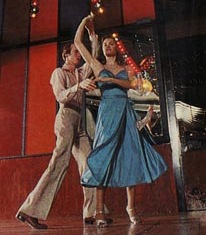
Butterfly (also called Walk Around Turn, Crossover and Passing Turn)
Take an open two-hand hold and walk around each other, turning clockwise or counterclockwise.
Follow's Outside Underarm Turn (also called Arch Turn and Outside Spin)
In Place: She does a CW spot turn in place; he stays in place.
Crossing Over: Woman passes forward by his left side, turning CW, as in 50s bandstand swing
Follow's Inside Loop Turn (also called Reverse Underarm Turn and Inside Spin)
In Place: She does a CCW spot turn in place; he stays in place.
Crossing Over: Woman passes forward by his right side, turning CCW.
Waist Slide (also called Belt Scratch)
He raises his free R arm slightly, walks forward toward his left breaking through held hands (scratching his belt buckle into held hands), as she walks forward past his left side.
One version has his R arm raised high. A disco film shows him changing her hand into his R.
2-Hand Loop-De-Loops (also called Wrap Turns, Woman's Walk Around and Loop Pass)
2-hand Follow's Loop Turn followed by 2-hand Waist Slide
Dishrag (also called Crossed Twirl and Twist Turn)
From either open 2-hand hold or crossed hands, he raises both hands to turn her under.
Wrap (also called Sweetheart, Cradle and Cuddle Turn)
From 2-hand hold he wraps her CCW in to his right side.
Wheel
Once wrapped up, both walk around the other. Whoever is wrapped usually backs up.
Reverse Wrap (also called Wrong-way Sweetheart and Reverse Cuddle)
From 2-hand hold, he leads his R hand inward to wrap her CW in to his R side, as he walks his R arm over her
head to her R shoulder. Then he raises his L arm to lead her straight forward under his L arm, then she turns right to
face him. Unwind crossed hands with Dishrag.
Lead's Wrap (Lead's Sweetheart)
From 2-hand hold, he raises his R hand and wraps himself CCW in to her R side.
Lead's Wrap and Duck-out
The same followed by a Wheel with him backing followed by his ducking and backing out.
Roll Off the Arm
From the Wrap he releases L, she unwinds to swingout at his right side.
Lateral Dip (only one of many disco dips and drops)
From Rolling Off the Arm, she spins back into Wrap, he lunges side L and she leans into his hip.
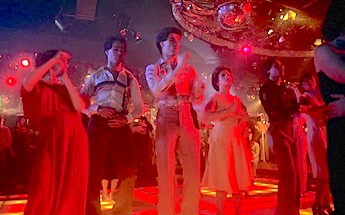 LINE DANCES
Another tradition revived from the late 1950s and early 60s was Line Dancing, where a group of individuals performed a routine of steps,
facing in the same direction, without partners. The Madison (circa 1958) faced in only one direction, and it was so complicated, with a dozen figures, that it needed
to be called by a prompter. It's believed that the Hully-Gully (1961) was the first short and easy line dance, and it was the first to
turn one quarter at the end of the pattern, to repeat facing a different wall. The Continental (Continental Walk) appeared at about the same time, also
sharing these two attributes. After that, most line dances were fairly short four-wall patterns.
The L.A. Hustle was one of the earliest disco line dances (circa 1974), renamed the Bus
Stop when it migrated to the East Coast. There were many versions of the Bus Stop. The Hot
Chocolate (1978) was a simplified version of the 1961 Hully Gully, then a decade later, the Country Western Electric Slide
(1989) was step-for-step identical to the disco Hot Chocolate. Other notable disco line dances were Travolta's Night Fever Line Dance from Saturday Night Fever,
the Hollywood Line Hustle, Rollercoaster, the New Yorker, the Pump, and Disco Duck.
John Travolta's 1980 film Urban Cowboy helped launch another dance craze—Country Western, which continued disco's line dancing, but with a cowboy flair.
DISCO BIBLIOGRAPHY The collection of Richard Powers
1974 Dick Blake DISCO DANCES (including 5 early kinds of Hustle) Cleveland
1974 Dick Blake THE NEW DISCO! TOUCH DANCING (many Hustles evolved forward, including Latin and NY Hustle) Cleveland
1975 Rolling Stone Magazine Disco Issue (10 articles) NY
1976 Adam VIII Ltd. YOU CAN LEARN TO HUSTLE Instruction Booklet w/ Disco Hustle LP NY
1976 The Hustle Factory DO THE HUSTLE - LP with vocal & printed instructions Terre Haute IN
1976 Arthur Murray Schools LET'S DANCE (with disco and Hustle) NY
1976 Rolling Stone, Publisher; Abe Peck, Editor DANCING MADNESS NY
1976 Jeff & Jack Shelley LEARN DISCO DANCING - LP with vocal & printed instructions NY
1976 Jeff & Jack Shelley LEARN DISCO DANCING - 8-track tape instructions NY
1976 Newsweek Magazine THE DISCO WHIRL (cover story) November 8 issue
1976 Tee Vee International, Inc. VOUS POUVEZ APPRENDRE LE HUSTLE Markham, Ontario
1977 Imperial Society of Teachers of Dancing DANCING BALLROOM, LATIN AMERICAN AND SOCIAL London
1977 Betty White BETTY WHITE'S HOW TO HUSTLE (book) NY
1977 Betty White HOW TO HUSTLE (LP instructions) NY
1977 Betty White HOW TO LATIN HUSTLE (LP instructions) NY
1977 Grant F. Longley LINE DANCE MANUAL MA
1978 Anon. GET DOWN, FEVER DANCE - mimeographed instructions
1978 Robert Audy JAZZ DANCING with disco dancing moves NY
1978 Skippy Blair DISCO TO TANGO AND BACK, Downey, CA
1978 Keith & Christine Burton DISCO FEVER DANCE BOOK Great Missenden, England
1978 Crane-Norris Marketing SATURDAY NIGHT DISCOMANIA
1978 Ann Czompo DISCO HUSTLE! Homer, NY
1978 Gabbert Elbert "DISCO FEVER" Subject Book (spiral bound notebook) with illustrated Tango Hustle description Birmingham, AL
1978 Uta Fischer-Munstermann JAZZ DANCE including DISCO DANCING NY
1978 Gateway Records HUSTLE, BUS STOP & LINE DANCES - illustrated instructions in LP
1978 Albert Goldman DISCO NY
1978 Albert Goldman, LIFE Magazine "The Delirium Of Disco" November issue
1978 Kitty Hanson DISCO FEVER NY
1978 Barbara Hegne DISCO FEVER
1978 Carole Howard THE COMPLEAT GUIDE TO SURVIVAL SOCIAL DANCE (including Disco) Minneapolis
1978 Imperial Society of Teachers of Dancing DANCING - STEP BY STEP (including Disco) London
1978 Janet Jasek DISCO LOVERS GUIDE TO DANCE South Bend, IN
1978 K-Tel Records LEARN TO DO THE HOT CHOCOLATE - illustrated instructions in LP NY
1978 Karen Lustgarten THE COMPLETE GUIDE TO DISCO DANCING San Francisco
1978 Roy Madrid DISCO... YOU SHOULD BE DANCING Los Angeles
1978 John Monte FRED ASTAIRE DANCE BOOK including Hustle, Latin Hustle, California Hustle New York
1978 Steve Ramacher LET'S DISCO, A Complete Instructional System for Disco Dancing MN
1978 Shelly Schunick DISCO STEPPIN' - instructions and LPs Baltimore, MD
1978 Time Magazine "Travolta Fever" (cover story) April 3 issue NY
1978 Aurora Villacorta DISCO Danville, IL
1978 Jack & Kathleen Villari THE OFFICIAL GUIDE TO DISCO DANCE STEPS Secaucus, NJ
1978 Lester Wilson DANCE DANCE DANCE
1979 Andy Blackford DISCO DANCING TONIGHT London
1979 Nancy Bruning THE KIDS' BOOK OF DISCO NY
1979 Bill Butler & Elin Schoen JAMMIN', Complete Guide to Roller Disco NY
1979 Joetta Cherry & Gwynne Tomlan DISCO DANCING NY
1979 Randy Deats DANCING DISCO NY
1979 Alma Heaton and Don Zimmerman DISCO WITH DONNY & MARIE
1979 Janet Jasek DISCO TEXT - The Complete Book of Disco Dance Instruction Lansing, IL
1979 Ann Kilbride & A. Algoso THE COMPLETE BOOK ON DISCO and Ballroom Dancing Los Alamitos, CA
1979 Kerry Kollmar ROLLER DISCO DANCING (with photos of Kevin Bacon) NY
1979 Jena Lauren DISCO Los Angeles
1979 Lauter Publ Co DISCO STEPPIN' OUT Magazine Vol. 1, No. 1 Hollywood, CA
1979 George Lloyd LEARN DISCO DANCING London
1979 Carter Lovisone DISCO HUSTLE
1979 Karen Lustgarten THE COMPLETE GUIDE TO TOUCH DANCING San Francisco
1979 Karen Lustgarten GUIDE COMPLET, DANSE DISCO Montreal Quebec
1979 Karen Lustgarten DISCO DANCING - EINE DISCO-TANZSCHULE FUR ALLE NEUEN TANZE Munich
1979 Judi McMahon A GUIDE TO DANCING DISCO NY
1979 Jennifer Meloney YOU CAN DISCO NY
1979 Roberta Morgan DISCO NY
1979 Arthur Murray Disco Dance Studio "DISCOPEDIA" DISCO DANCE LESSONS (series of 4) NY
1979 Newsweek Magazine "Disco Takes Over" cover story April 2, 1979 NY
1979 David Peterson & Laura Trepanier DISCO JUNCTION, Dance Book 1 Minneapolis, MN
1979 Bruce Pollack THE DISCO HANDBOOK NY
1979 Maxine Polley DISCO BASICS Englewood, NJ
1979 Rolling Stone Magazine "Disco" April 19, 1979
1979 Brian Sherratt DISCO CHIC NY
1979 Deney Terrio THE PROFESSIONAL APPROACH TO DISCO INSTRUCTION NY
1979 Lani van Ryzin DISCO NY
1979 Betty White HOW TO DISCO DANCE (with audio cassette) NY
1980 MAD Magazine DISCO - Special issue on disco, with a vinyl parody disco record
1980 Dennis Fallon THE ART OF DISCO DANCING St. Louis, MO
1980 Ronald Lackmann DISCO! DISCO! DISCO!, A Guide to Disco Dancing Middletown, CT
1980 Leonard McGill DISCO DRESSING NJ
1980 Vita Miezitis NIGHT DANCIN' NY
1980 Jerolyn Ann Nentl DISCO DANCING Mankato, MN
1981 Pamela Morton BASICS OF DISCO DANCING. Boston
Stanford Home Accessibility