
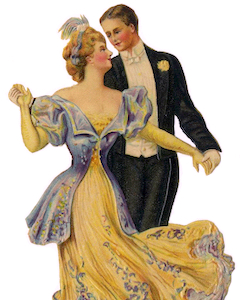
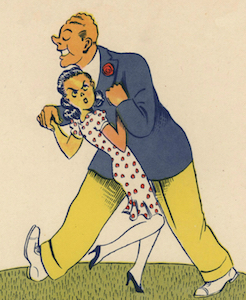
before after
Partnering Before and After the Vote
Richard Powers
A preliminary note about terminology: My other Web pages have de-gendered the terms Follow and Lead, but it is appropriate for this one page, on gender politics, to keep the original terminology of women and men.
Never should the so-called gentler sex be quite so gentle and acquiescent as when dancing. No matter what her views on suffrage and feminism may be, it is a woman's duty to let the man lead on the ballroom floor. His is the guiding spirit; hers, the following. He is the pace-maker; she is his shadow.Suffrage and feminism?! Yes, this new ballroom dance attitude developed soon after American women won the right to vote, leading to a backlash from some men.
Now, men, in these days of sex equality you can take heart from the fact that, on the dance floor at any rate, the man is still the boss. It is he that decides when and where any particular step is danced. He designs the pattern of the dance. The man will do most of the work while his partner just makes a pretty picture. Now for the ladies, you don't have much to say in the matter at all.The British ballroom champion Victor Sylvester gave simpler advice to women in 1927: "Submit yourself entirely to your partner." And Arthur Murray thought that women wanted it this way: "The dance floor is the one place where the weaker sex prefers to remain submissive."
The lady's part is to follow, whether the man is dancing a figure correctly or not. She must not have a mind of her own. She must just follow whatever the man does and not attempt to correct him.The American George Raft took "must not have a mind of her own" a step further, saying,
No girl with much intelligence will suit me because once a dancing partner has any grey matter she tries to figure out ideas on her own, whereas she should merely think and move like machinery.Note: That was not an obscure quote. It was featured prominently in the April 1934 issue of the Dancing Times magazine, which was read by every serious ballroom dancer at the time.
Pressure with the heel of the right hand on the left of the girl's vertebrae will turn her to the right. The leader gets his partner to cross her left foot over the right foot by pressing with the heel of the right hand.
The man should remember that there are two basic uses for a lead. The first is to make a change of position, the second is to get the girl to do the step.
When a girl does not react readily to her partner's lead, he should hold her firmer and give a stronger lead.
— Israel Heaton, Brigham Young University, 1954
The man's responsibility to care for his partner:
"A little watchfulness can almost always avoid collisions, and a good dancer would consider himself disgraced if any mishap occurred to a lady under his care."
— Routledge's Ballroom Companion, London, ca. 1865
Note that the man's concentration is on protecting his partner from harm.
Then almost a century later:
"Ladies, may I ask for a little forbearance if, through his concentration on his steps [note where the man's concentration is now] he should inadvertently run you into the wall or fail to see the chair that got in the way and caused you to sit on the floor?"
— Courtenay Castle, London, 1958
Concerning a lady correcting a gentleman:
"If the gentleman is so inexperienced as to force the lady backward [note: it was dangerous because women's ballgowns had a short train in 1875, which she could step on if she were to step backwards], she should check it by immediately turning herself to the right or left, at the same time notifying him that it is dangerous."
— Wm. DeGarmo, NY, 1875
Then ninety years later:
"At no time should the girl criticize the man's dancing — unless she prefers dancing without a partner." (The italics were his.)
— Richard Kraus, Columbia University, 1965
The Dark Ages
Review all of those early 20th century quotes again. What was the emphasis of Kraus, Heaton, Silvester, Ray, Castle, Moore and Murray? Women enjoying dancing? Or women obeying men?
Today
Although a few ballroom teachers and dancers are still stuck in the Dark Ages of ballroom dance, the best dancers and dance teachers today have completely rejected that attitude, and now emphasize mutual respect
between dance partners. As mentioned on the main page, aware Leads know and care what is comfortable for their partners, what is pleasurable and fun for them.
Disclaimer: Not all men had a controlling attitude toward their partners in the 1920s to 1950s. Many men at that time respected their partner's differences, were kind and flexible, and adapted to their various partners on the dance floor. A women I interviewed told me, "I knew plenty of men who treated their dance partners disrespectfully, but my husband was always a perfect gentleman."
But never before had the above "dark ages" attitude been so prevalent, or committed to print in dance manuals.