Vernon and Irene Castle were the most famous and influential dancers of the Ragtime Era.
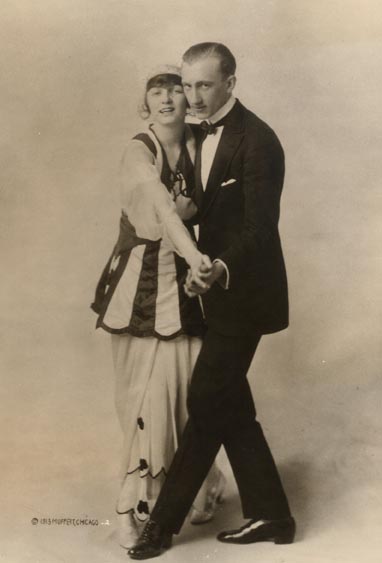
In 1915 Vernon Castle volunteered to fight in the war and served with the
First Squadron, Royal Flying Corps, stationed at Bailleul, 135 miles north of Paris.


Vernon is credited with shooting down a German two-seater biplane on Nov 27, 1916 at Vlamertinghe, Belgium.
Vernon was piloting a two-seater Nieuport 20.
A Nieuport 20, perhaps Castle's, at Vernon's 1st Squadron RFC at Bailleul:

Here is Vernon's own sketch of that battle:

This was a dangerous year to be flying for the Allies because Germany had introduced the heavily armed Fokkers which completely dominated the air in 1916 (known as the year of the "Fokker scourge"). By the end of 1916 the Allies introduced their answer to the Fokkers: the French Nieuport 17.

During December of 1916 Vernon was assigned to fly new Nieuport 17s from the depot in Villacoublay, near Paris, to his squadron's field in Bailleul. He would have kept his own cockpit aerial map with him as he ferried in the Nieuport 17s.

The aluminum and celluloid cockpit maps were made for Aéronautique Militaire by S.F.A. — Service des Fabrications de l'Aéronautique.

Since he kept his cockpit aerial map with him, Vernon scratched his name in the back.
Vernon's map case is now in my collection.


The maps on rollers changed depending on the flight assignment. The map roll in Vernon's case scrolled from Bailleul in the north to the Nieuport depot at Villacoublay, at the south end of the map. Airfields were drawn in black. Villacoublay on Vernon's map is in the center below. Versailles is at the left. Today Villacoublay is a large military airfield.

Here is Jean Louis Conneau, who designed this style of cockpit map case in 1911:

Vernon was credited with a second victory, an Albatros D.III, which he shot down in flames on March 11, 1917 at Poezelhoek, Belgium, over enemy territory, while flying his new Nieuport 17. Vernon's sketch is on the left:

Vernon Castle was awarded the Croix de Guerre in 1917.
Being a scale model geek, I made a map case for my model of Vernon's Nieuport 17.
(You can tell it's geeky because the knobs on the map case turn.)

Vernon survived two years of aerial combat in France, then was sent to a training base in Texas to train American pilots in aerial combat.
On February 15, 1918 Captain Vernon Castle was killed, at the age of 30, in a training accident. Another plane was flying below Vernon's, didn't know there was a plane above him, and suddenly pulled up, colliding with Vernon's plane. Normally the instructor sat in the rear seat, but an earlier training accident had killed one of Vernon's trainees, who was in the front "death seat," so Vernon always took that seat himself afterwards. His trainee survived this accident.

This was the funeral in Texas.


Photographs from the collection of Richard Powers
Accessibility